Sunday, January 22, 2012

One Hundred Years Ago Today...


...Henry Flagler rode a train all the way to Key West. Today we don't think too much of driving over a seemingly endless chain of islands and bridges as we drive from Florida's mainland to Key West (with a stop at the History of Diving Museum on the way, of course). But in 1912, it was a very big deal. Nothing like it had ever been attempted.


The Key West Extension of the Florida Keys Over-Sea Railway was called "Flagler's Folly,"a nod to the fact that many thought it was an impossible feat. But Flagler proved them all wrong on January 22, 1912 when he and wife, Mary Lily, rolled into town on a special Pullman sleeping car. After seven years of setbacks, Flagler's dream had finally come true. For a complete historical timeline of the Florida Keys Over-Sea Railroad, visit this website: http://www.flaglerkeys100.com/fec-railroad-overseas-extension


As this month marks the centennial of this occassion, there has been an upsurge in this (almost) unbelievable story. Several new books have been published, new documentaries produced, and a host of special events held to commemorate this special anniversary.


One thing that hasn't changed much is that we still know very little about the divers who were involved in building the Over-Sea Railroad. There are only two known photographs showing divers from this project. Both are from the collection of the Pigeon Key Foundation.


The Miller-Dunn Divinhood was just coming into popularity at this time, but the divers who worked on Flagler's Railroad wore hard helmets bolted to canvas suits. In other words, they were full-dressed divers. Note the large air pumps in the two photos below. A lot of man power was needed to allow the divers simply to breathe.


We hope you enjoyed these photos. They are staff favorites here at the History of Diving Museum. As always, we're looking for more, so let us know if you know of any other photos of divers from this project or era.


Happy Centennial, Henry!


-Erin
Interim Director/Manager of Collections and Administration

Tuesday, December 20, 2011

Under Pressure: Decompression Chambers

I have to admit, decompression sickness and hyperbaric medicine are two things I know very little about. They are both complex subjects, so I'm very thankful - and grateful - for the doctors who are able to utilize pressurized chambers and oxygen, a gas that we all breathe every single day, to save lives.

Decompression sickness (DCS) is a very serious issue for our sport. Originally coined 'caissons' disease' in the 19th century, it was first discovered in bridge construction workers who experienced joint pain upon returning from working in pressurized enclosures (caissons) at the bottom of rivers and lakes. Today it is commonly referred to as "the bends."

Here at the History of Diving Museum, we have two decompression chambers. The one below is located just outside our building and dates to the 1960's. It features a very simple cylindrical design and two view ports to observe the patient.


It is considered roomy compared to the collapsible chamber located inside our "Abyss" exhibit. This is an extremely rare chamber made by the German company, Drager. Its telescopic quality allows it to fit inside a small box and expand quickly for emergency situations aboard a ship. It also features two view ports for observation.


If you are interested in learning more about how hyperbaric chambers are used to treat the bends and other ailments, join us at the Museum on Wednesday, December 21st at 7pm. Dennis Holstein, Program Director for Hyperbaric Medicine and Would Care Departments at Mariners Hospital, will present a free program, "Hyperbaric Medicine: It's Not Just for Divers."

-Erin
Manager of Collections and Administration
All photos courtesy of the History of Diving Museum

Tuesday, November 22, 2011

Exhibit Talk: Transforming the South Florida Room


Our team has been hard at work on transforming one of our most popular exhibits, The South Florida Room, so I wanted to give an update on the amazing progress that has been made in the past few months.


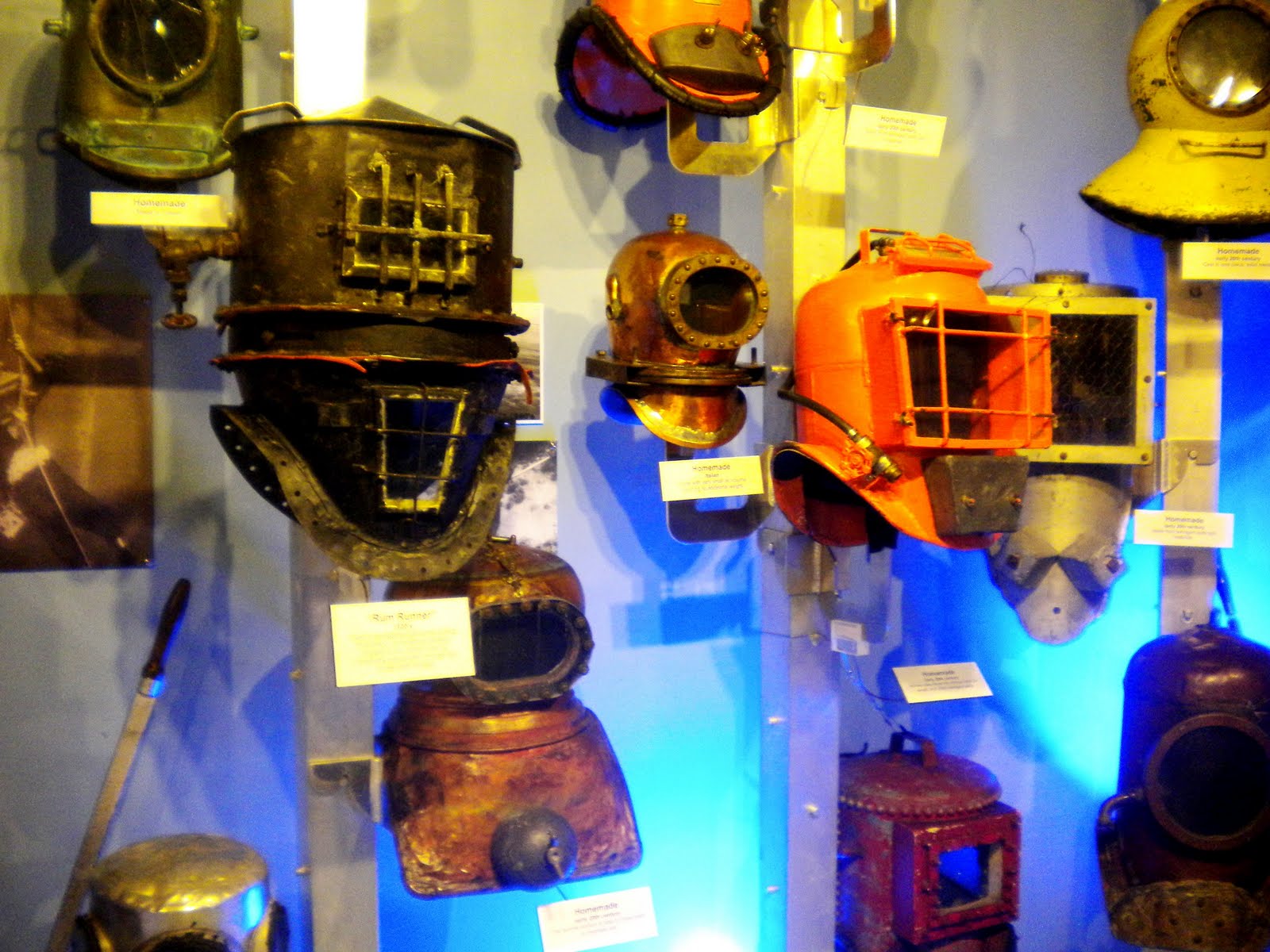
Some of my favorite helmets in our collection can be found in the South Florida Room. The exhibit centers on the Divinhood - the world's first commercially produced open bottom helmet which unquestionably changed diving history. The story of William Miller and William Dunn's Divinhood is a great one - but it is our collection of homemade helmets (inspired by the open bottom concept the Divinhood introduced) that seem to be some of the most popular and memorable artifacts, both for our staff as well as our visitors.


Above is one of our more famous - or infamous - helmets. Dubbed "The Rum Runner," this homemade helmet was used in the 1920's in smuggling operations during Prohibition. Contraband whiskey dropped in the Detroit River by Canadians was spotted through the breastplate window.

The concept of the open bottom helmet was so simple and useful, that craftsmen in garages started using household items to build their own version of the Divinhood. What they produced were many oddly shaped helmets, each truly one-of-a-kind.


Our curator of exhibits, Tim Hemsoth, is finishing this newly constructed wall as I type and it's looking really fabulous. As you can see from the "Before" and "After" photos, Tim has created a "forest" of helmets from floor to ceiling, backlit with a blue spotlight. Enjoy the photos and below and let us know what you think!

Before


After

As a result of redesigning the floor plan in the South Florida Room, we'll also be making some changes to our Underwater Photography exhibit and the Treasure Room in the near future. Below you can see we've taken a wall down to open up the entrance to the Treasure Room and create a better traffic flow.

Hope you've enjoyed seeing all the updates. Stay tuned for more!

-Erin
Manager of Collections and Administration

All photos courtesy of the History of Diving Museum

Friday, November 4, 2011

Henry Fleuss: An Early SCUBA Pioneer

Henry Fleuss (1851-1933) was a diving engineer for Siebe, Gorman & Co. of London. He is widely recognized as a pioneer in the field of diving and some even credit him as the first SCUBA diver. You didn't think it was Jacques Cousteau, did you?


Though he is credited with many other inventions including the Fleuss vacuum pump and a steam car, it is widely accepted that his most important was for the first self-contained breathing apparatus (SCUBA) using pure compressed oxygen. Originally designed in 1876, he was granted a patent for the apparatus in 1878 which freed the diver from having to rely on breathing surface-supplied air.


The apparatus consisted of a rubber mask, a breathing bag, a copper tank to hold the oxygen, and a scrubber. The closed-circuit system was designed to reuse the oxygen by removing the carbon dioxide using a rope yarn soaked in a solution of caustic potash. Originally used to rescue mine workers, Fleuss was lauded for this early SCUBA apparatus.

Its revolutionary and brilliant design became an invaluable piece of equipment for military operations during WWII. The Fleuss rebreather came to be preferred over all other available diving apparatus because it offered the diver total concealment (no air bubbles!).

Although the Fleuss rebreather limited the diver's working depth due to the threat of oxygen toxicity, it was truly revolutionary and is without a doubt a very important part of diving history.

Visit the Museum to learn more about early rebreathers and the evolution of other early SCUBA equipment!

-Erin
Manager of Collections and Administration

Sunday, October 30, 2011

Jake's Journey: Closer to Home


Meet our friend Jake. Some of you may have had the chance to see him on display at First State Bank in Key Largo where he has been on loan for the past two years. Jake has served as an outreach tool for the History of Diving Museum by helping to spread the word about our institution while making many new friends.

After his assignment in Key Largo was up, we were very happy to receive news that Hampton Inn and Suites in Islamorada was interested in 'adopting' Jake to become part of their family. When they assured us that Jake would have plenty of play dates with friends from around the world every day of the week, we knew it was a perfect fit! We are so happy to announce Jake's return to Upper Matecumbe Key. He is now on display just inside the lobby - ready to greet guests and again serve as an ambassador for the Museum.

'Jake', a full-dressed diver on loan from the History of Diving Museum, is now on temporary display at the Hampton Inn and Suites in Islamorada, Florida.

After about a month in his new home, we can report that Jake is very happy and feeling settled. We are so happy to have him closer to home!

The next time you are passing by, visit Jake and make sure he's behaving himself.

-Erin
Manager of Collections and Administration

Friday, October 21, 2011

A Diver and His Helmet: A Happy Reunion

It was a routine business call that brought Jon Hazelbaker to Upstate New York last week, but the series of events that took place were anything but ordinary.

In 1986, commercial diver Jon Hazelbaker was working on a big diving project in Corinth, New York for the International Paper Company. After about three months, the job was almost complete. However, he was called back for a few more days to work on another part of the power plant. After packing up his gear - helmet and everything - Hazelbaker headed back into Albany and checked in to a hotel around 1 o'clock in the morning. The next day started early around 6am. and as he was checking out of the hotel, he discovered that his truck had been broken into. His helmet was gone.

This discovery was completely disheartening, not only because of its obvious monetary value, but because Hazelbaker had accumulated literally thousands of hours working time in it; it was a helmet that he had used and lovingly abused for 16 years.


Devastated, he took out ads in local newspapers and trade magazine with a photo of the helmet (pictured above) and offering a reward for its return. He even sent out letters and photos to local dive shops and other commercial dive firm competitors.

Flash forward 25 years to 2011 when Hazelbaker was assigned by ADCI to perform a safety audit for commercial diving firm Seaway Diving & Salvage - a routine practice in the industry. While scheduling his visit to Waterford, New York, Hazelbaker recited the story of his stolen helmet to the owner of Seaway, Tim Joslyn. After a few minutes, Joslyn said, "I think we have that picture still here." He quickly located the original photo from 1986 in a file and told Hazelbaker that he knew where that helmet was. The previous owner, Kevin Lengyel, had kept the photo around all those years. Overwhelmed with joy, he exclaimed over the phone, "Tim, that is my hat!"

After taking care of business at Seaway, Hazelbaker took Joslyn's advice and soon found himself en route to a dive shop in Clifton Park, New York - ready to get his hat back. Upon arrival, Hazelbaker was asked to identify the helmet in detail, and of course he was able to recall each and every fitting and dent in the helmet, many unique to this particular hat. After a little while, he was finally reunited with his old helmet, almost 25 years to the day when it was stolen.

Commercial diver Jon Hazelbaker reunited with his helmet in Upstate New York.

Hazelbaker gives credit to the owners of Seaway for this happy reunion; to Kevin, who kept the picture around so long, and to Tim who is responsible for putting all the pieces together.

If you have any happy stories like this one, we would love to hear about them!

-Erin
Manager of Collections and Administration

Capt. Jon Hazelbaker is a commercial diving consultant and Board Member at the History of Diving Museum.

Tuesday, October 11, 2011

Remembering an Aquanaut: Dewey D. Smith

As we gear up for our next event, I can't help but to be reminded of a certain helmet in our permanent collection. Next week's program, "Space Exploration and the Aquarius Underwater Habitat" will be presented by a team of Aquanauts and talk about their latest mission with NASA.


NOAA Aquarius Reef Base, colloquially known as Aquarius, is an underwater laboratory located in 63 feet of water approximately 3 1/2 miles offshore of Key Largo in the Florida Keys and is often used by marine biologists studying the reefs. For the past 10 years, NASA has used the underwater habitat for its NEEMO missions to study the effects of extreme environments.

On May 5, 2009, NOAA, Aquarius, and the diving community lost a friend and true hero. Dewey D. Smith was a habitat technician for Aquarius who passed away at the age of 36 as a result of a diving accident. He had worked as a diver with Aquarius for two years and previously served in the US Navy as a Medical Corpsman for five years.

His passing truly left a huge void in the Aquarius family. In honor of Smith's life and legacy, the Aquarius Reef Base donated a Superlite 17 helmet to the Museum. The Superlite 17 is a modern helmet with a fiberglass shell and built-in demand regulator and is the helmet most frequently worn by the Aquanauts. Initially on special display in our Research Library, we are happy to announce that it is now on permanent display in our Commercial Diving exhibit (yellow helmet pictured below).

Every time the Aquanauts come to the Museum for a presentation, you can be sure to find each one paying a visit to the commercial diving exhibit where they remember their friend. We are proud to display this helmet and and honored to present it in memory of Dewey. He will surely be present in all of our thoughts on Wednesday.

-Erin
Manager of Collections and Administration