Showing posts with label Miller-Dunn. Show all posts

Tuesday, November 22, 2011

Exhibit Talk: Transforming the South Florida Room


Our team has been hard at work on transforming one of our most popular exhibits, The South Florida Room, so I wanted to give an update on the amazing progress that has been made in the past few months.


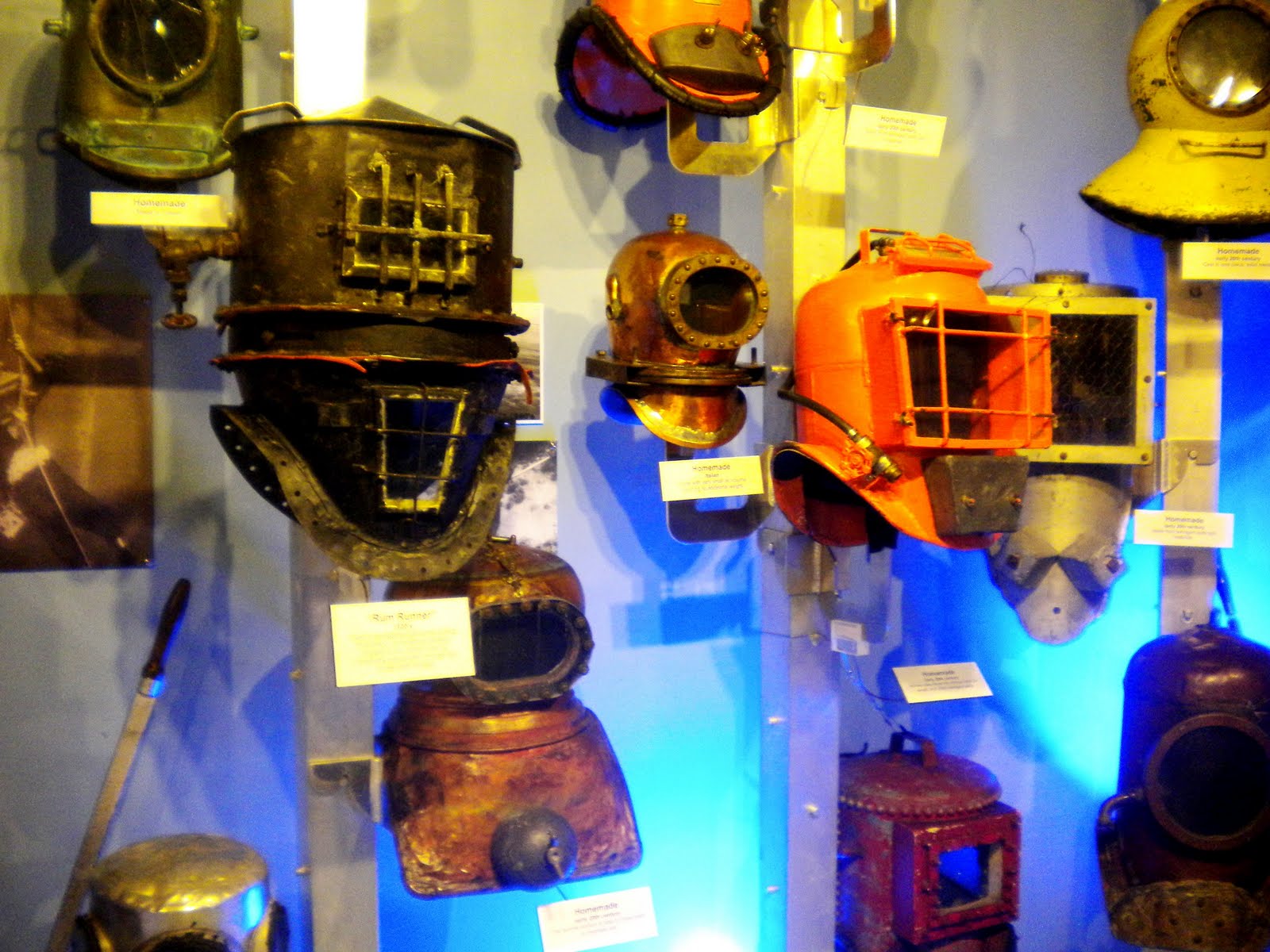
Some of my favorite helmets in our collection can be found in the South Florida Room. The exhibit centers on the Divinhood - the world's first commercially produced open bottom helmet which unquestionably changed diving history. The story of William Miller and William Dunn's Divinhood is a great one - but it is our collection of homemade helmets (inspired by the open bottom concept the Divinhood introduced) that seem to be some of the most popular and memorable artifacts, both for our staff as well as our visitors.


Above is one of our more famous - or infamous - helmets. Dubbed "The Rum Runner," this homemade helmet was used in the 1920's in smuggling operations during Prohibition. Contraband whiskey dropped in the Detroit River by Canadians was spotted through the breastplate window.

The concept of the open bottom helmet was so simple and useful, that craftsmen in garages started using household items to build their own version of the Divinhood. What they produced were many oddly shaped helmets, each truly one-of-a-kind.


Our curator of exhibits, Tim Hemsoth, is finishing this newly constructed wall as I type and it's looking really fabulous. As you can see from the "Before" and "After" photos, Tim has created a "forest" of helmets from floor to ceiling, backlit with a blue spotlight. Enjoy the photos and below and let us know what you think!

Before


After

As a result of redesigning the floor plan in the South Florida Room, we'll also be making some changes to our Underwater Photography exhibit and the Treasure Room in the near future. Below you can see we've taken a wall down to open up the entrance to the Treasure Room and create a better traffic flow.

Hope you've enjoyed seeing all the updates. Stay tuned for more!

-Erin
Manager of Collections and Administration

All photos courtesy of the History of Diving Museum

Friday, September 2, 2011

The Divinhood: Practical and Profitable

"A diving apparatus so simple anyone can use it."

That was the slogan for the Miami-based Miller-Dunn Company who designed and produced the Divinhood helmet in the early part of the 20th century. A summary of the significance of this helmet can be found in an earlier blog entry here.

As you may know by now, we love the Divinhood. But before the Style 2 gained fame as the centerpiece for the History of Diving Museum's logo, it was lauded at the time by many for its simplicity, affordability, and practicality. Today I wanted to share with you some contemporaneous quotes from those who used the Divinhood and shared their success stories with Miller and Dunn themselves.

"We want to thank you for building it and congratulate ourselves for buying it."
- W. H. Ebsary, January 12, 1926

"I would not be without it."
- E. F. McDonald, Jr., September 29, 1927

"This is to inform you that since the receipt of the Divinhood we purchased from you two weeks ago, we have recovered over $500.00 worth of merchandise that had gone overboard in Biscayne Bay and could not be found by skin divers. It has already paid for itself."
- John. T. Bennett, July 1st, 1925

"I sat down on a convenient rock, shut my eyes and recited to myself, 'I am not at home, nor near any city or people; I am far out in the Pacific near a desert island, sitting on the bottom of the ocean; I am deep down in the water in a place where no human being has ever been before; it is one of the greatest moments of my whole life; thousands of people would pay large sums, would forego much for five minutes of this!' "
- William Beebe, New York Zoological Society, December 25th, 1925


William Beebe in the Miller-Dunn Style 2 Divinhood

All quotes taken from American Dive Catalog Collection by Ray Mathieson.

-Erin, Manager of Collections and Administration

Sunday, May 29, 2011

Part II, the U.S. Navy Mark V

Hello HDM blog-followers! Good to have you back with us for Part II of the U.S. Navy Mark V saga! This blog entry will provide an overview of the components of the Mark V. For those of you who missed Part I, (the history of the Mark V) I urge you to reference back here before reading this blog.


"The U.S. Navy Mark V is the most coveted and recognized diving helmet in the world. It embodies helmeted diving with its bold look, functional design and long-standing history in American diving."


Stream-lining of the Mark Helmets

An earlier age of diving pioneers held the belief that the more extravagant and involved a diving apparatus, the more sophisticated it was, and therefore, the better it would be to convey a diver to depth. By the turn of the twentieth century, helmet manufacturers came to this realization that the more extravagant the design, the better chance something would fail, and there began a shift toward simplicity.

The U.S. Navy Mark V was created during the diving craze of the early twentieth century, when many different helmets were produced and knowledge about diving was becoming increasingly common. By 1917, G. L. Stillson completed the design of the Mark V, but at the time, no one could have foreseen the impact it would have on the history of diving.

This, of course, begs the question, what was different about this helmet that separated it from helmets of the same generation? Well, when Stillson called for the standardization of the Navy dive program, they needed not only good equipment, but it had to be the best. Main considerations were that it had to be easily fixable, comprehensible by the average enlisted-man, and sufficient for deep-dives. The combination of these requirements produced a well-built unit that would be used by the U.S. Navy for more than fifty years!

The design of the helmet, the placement of the components, and the size and weight considerations were completed by a process of trial and error. Four helmets were constructed and tried: the Marks I, II, III, and IV, and the best aspects from these four designs were used to build the Mark V helmet.


Early Mark Helmets: I-IV

Two companies manufactured the early Mark helmets. The Morse Company of Boston was first commissioned to build helmets to the navy standard. The identifying feature of the Morse helmets is the oval shaped side ports. The Shrader Company of New York was commissioned to build early Mark helmets as well but with their design instead, has circular side ports. Below are the Mark I-IV helmets made by Morse and Shrader:


The protagonist, the Mark V...

The Navy used the Marks I-IV, as shown above, with great success for many years, but with four designs in circulation, there still wasn't a standard helmet for the diving program (which was the original purpose of improving the diving program). Incorporating various design features of the earlier Mark helmets, allowed for the Mark V helmet to take on a common shape and features.

The Navy commissioned four companies to produce the Mark V diving helmets. They continued the already existing tradition with the Shrader and Morse Companies, but added the Diving Equipment and Supply Company (DESCO) of Milwaukee and the Miller-Dunn Company of Miami.


Morse Mark V


Schrader Mark V


DESCO Mark V


Miller-Dunn Mark V


Mark V Expanded

The strategic placement of the components separated the Mark V from all other helmets. The Mark V remained the U.S. navy standard from 1915 to 1979 while it remained largely unchanged.


Front View


Side View


Top View

Symbolism of the Mark V

The longevity of the helmet's application both militarily and commercially are are symbolic of the United States military at large. It stands as an identity of the ingenuity and design associated with the military similarly to the M16 rifle and the M113 tank.


If you ever get a chance to dive a Mark V you will understand why they are among the best ever made.

Monday, August 16, 2010

The U.S. Navy Mark V

It's hard to believe, but the History of Diving Museum Collections Blog is entering into its third month of online diving history! The focus of this blog has been to inform readers on the history of artifacts within the collection. So far, I have chosen only those items with great significance to diving and Florida Keys history. Although diving bells, Art McKee, the first American diving helmet and the last petroleum lamp are very important, I have somehow neglected quite possibly the most important piece of diving history...

The U.S. Navy Mark V is the most coveted and recognized diving helmet in the world. It embodies helmeted diving with its bold look, functional design and long-standing history in American diving. Navy Dive Master Carl Brashear (his story was the inspiration for the movie Men of Honor) used a Mark V during his career. Today, it symbolizes not only an important segment in diving history, but also stands as one of the most important technologies in the history of the world.

On to the history...

The U.S. Navy discovered a growing need for a standardized diving program. To the surprise of many, at the turn of the century the Navy had neither a standardized procedure or equipment for the diving program. Consequently, they were diving any and all equipment available, often with little knowledge of the dangers associated with diving.

In 1912, Navy Gunner G.D. Stillson wrote a letter to the Bureau of Construction and Repair (Bureau of Ships as it is called today) concerning the current diving program or lack thereof! He assembled a team and began a critical analysis of existing diving procedures. In the following years, Stillson and his team were commissioned to evaluate, improve and redesign every part of the diving program.

This evaluation produced two major developments. By 1915 G. D. Stillson, through the intercession of the Bureau of Construction and Repair, completed the first U.S. Navy guideline for diving known as the Report on Deep Diving Tests. This report served as the framework for Navy diving in the years to come. In it, Stillson discussed the necessary decompression times for deep dives, principles of pressure and most importantly, the equipment fostered through the program.

In Stillson's evaluations, he tested a wide variety of diving equipment, mostly those from the Schrader and Morse Companies, but also equipment from Draeger and Siebe. In the two years leading up to the completion of the Report on Deep Diving Tests, a standardized equipment would be developed for the U.S. Navy, giving birth to the Mark I!

The Mark V helmet, the standardization of the diving program and the self evaluation of the program, symbolizes the future of the U.S. military as we know it. Mark, a work frequently associated with military hardware, simply means a 'standard' or 'variant.'

Stillson and the Navy experimented with four versions of the Mark helmets, the Mark I, II,III and IV. The Mark V combined the best aspects from the previous four helmets. The final version was completed in 1917 and remained largely unchanged until its decommission in 1984. It is believed that only a mere 7,000 to 10,000 were ever constructed.

Four companies were commissioned to build the Mark V. The first Mark V helmet was made by the Morse Company; it is also the most common. Schrader, Desco and Miller-Dunn were also commissioned to build the Mark V. The Miami based Miller-Dunn Company produced the fewest helmets making them the rarest by today's standard. Out of the hundred or so helmets manufactured by the Miller-Dunn Company, the History of Diving Museum has two on display.

A Mark V helium rebreather version was also developed. The helmet has a large helium scrubber on the back. Of course, adding a large helium scrubber serves as a reservoir for more air, adding increased force buoying the apparatus and diver to the surface. To offset this affect, the helium Mark V needed increased weight to compensate for this added force. The boots are larger and lace just below the knee (a rather stunning look for those who have seen the design). The 'Banana Exhaust' was moved from the back of the helmet to the top where it was excluded from its original placement due to the scrubber. Lastly, the dumbbell lock was moved from the rear of the helmet to the front.

In the late 1970's, the Mark helmets changed completely. No longer a metallic base, the Marks are now fiber glass which changed the identity forever. HDM displays a newer version from the Mark line. The Morse Mark XII is the successor to their line of copper helmets. The top part of the helmet can be used alone for swim diving with air supplied by a hose from the surface, or a backpack or used with a 12-bolt attachment. It is much lighter than the original Mark V diving dress.

The Mark V is the icon of helmeted diving, thus this blog cannot be completed without a more in depth look at the helmet. This will be a two-part blog; the second part will provide an overview of the components on the Mark V. If you would like to learn more about what made this helmet one of the best manufactured technologies of the twentieth century, stay tuned for our next blog! The History of Diving Museum is the largest collection of historical diving apparatus in the world, we're proud to be your source for diving history!

Sources:
http://www.pricesforantiques.com/ (accessed 08/28/2010)

Tuesday, July 6, 2010

Art McKee: The Father of Modern Treasure Hunting

The evolution of modern salvage diving can be understood through life of one man. Arthur McKee Jr., considered the "father of modern treasure hunting," was the first to recognize that the reef-riddled Florida Keys provided a precious landscape for wrecked ships carrying even more precious cargo. He would be the first to salvage these ships, and in the process, become a pioneer in the salvage industry and the history of diving.

Art McKee (1910-1979) rose from meek beginnings before making his mark on history. A native of Bridgetown, New Jersey, he had a natural fascination for the underwater environment. As a young boy he is noted to have read books such as: On the Bottom by Commander Ellsberg and I Dive for Treasure by Lieutenant Harry E. Riesenberg, foreshadowing an early passion for his later achievements.

Art's first experience in diving came at the coat tails of a major storm that devastated the South Jersey Shore in 1934. A hard-hat diver commissioned young Art McKee to assist in the salvage effort of the collapsed bridge that connected east and west Bridgetown. At the time, McKee was a mere line tender and assistant of sorts but would continue in bridge building efforts to someday become a hard-hat diver himself.

As fate would have it, McKee suffered a knee injury in 1936 forcing him to South Florida where he could rehabilitate in the warm South Florida water year-round. Initially, he was hired to assist in repairing the underwater pipeline that supplied freshwater from Homestead to Key West, a trade he was familiar with from his days in New Jersey.

A key development in the Art McKee story was when he replaced the standard diving equipment with an open-bottom helmet because the full diving-dress was too warm for the south Florida waters. He replaced it with the Miller-Dunn "Divinhood," (pictured on the left with Art McKee) a design absent of a diving suit. He found the apparatus practical not only for its cooler temperature but for the simplicity of the unit. The standard diving-dress would take a team to suit-up a diver, whereas the Divinhood could be used by a single diver with only the help of a pump operator. Even with the advent of swim-diving, Art remained loyal to the apparatus, a technology he believed much of his career was owed.

Art's first experience in salvaging came when his preparation as a hard-hat diver met opportunity. He was notified by a local fisherman about a cannon protruding from ballast stones a short distance from Key Largo. What first appeared to be scrapped metal turned out to be remnants from the wrecked ship, Capitana el Rui (from the Spanish treasure fleet that wrecked in 1733). Art McKee spent the next 20 years salvaging the wreck, but this was only the beginning of his legacy in the salvage industry.

The turning point in Art's career was when he discovered his first silver bar. Locally, his legend as a salvage diver was growing. Art was contacted by Dr. Barney Crile, chief surgeon at the Cleveland Clinic, about a wreck off Looe Key. Dr. Crile commissioned Art McKee to investigate the site, in what turned out to be the "Ivory Wreck" (a slave ship that wrecked in the 1700's). Named for its contents, together they recovered ivory tusks and silver bars. Dr. Crile recorded the salvaging of the wreck in his book entitled, Treasure Diving Holidays, which contains pictures of Art McKee, ivory tusks, and the Miller-Dunn Divinhood.

Before long, Art had acquired a large collection, and realizing the general public was interested in his new found trade, the logical progression was to open a museum to display his artifacts. The Museum of Sunken Treasure was initially located in Treasure Harbor in Plantation Key, where the building structure remains to this day. As Art continued in his career and the collection continued to grow, the limited space at the first museum proved inadequate to house the collection. The final landing spot for the museum was in Art McKee's Treasure Castle. Today, most would recognize it as the Montessori School or Treasure Village. When the museum opened it was a major landmark and the premier tourist attraction in the Upper Keys.

Much of Art McKee's success is owed to his extremely driven and charismatic personality. Art was featured in LIFE Magazine and appeared on the Dave Garroway Show, proof that Art McKee had truly become famous. He persuaded some of the world's best underwater minds to join him in salvage efforts. Ed Link (best known for the invention of the Link Trainer) and Mendel Peterson (curator and head of archaeology at the Smithsonian Institute) became involved in various capacities with Art McKee. Together, they assume credit for developing the tools for modern salvage diving. They invented the underwater metal detector, jet propulsion vehicle, and sifting cage.

Although Art McKee achieved great success as a salvage diver, it was his insatiable appetite for adventure that kept him searching. He was one of the first to excavate Port Royal, but his dying wish was to find the wreck of the Genoves. The mother-load of wrecks, the Genoves contained 3 million pesos of gold and silver. Art McKee launched several expeditions with no success, but shortly before his death in 1979, he discovered the wreck of the Genoves.

Today, information on the life of Art McKee is scant, and his achievements in the salvage industry are just a part of the history of the wrecks that he salvaged. However, diving history allows for the proper avenue for his life to be memorialized. The History of Diving Museum has a single diver on the outside of the building. Due to his impact on diving and the Florida Keys, the museum chose to portray Art McKee as part of the mural on the building's facade, and inside the museum the Treasure Room displays an exhibit commemorating the extraordinary life of Art McKee.