Showing posts with label diving history. Show all posts

Tuesday, March 19, 2013

Diving into History at Disney


Board Member, Patti Gross
Photographed in Mark V Dive gear
The stated mission of the History of Diving Museum is to “tell the story of man’s quest to explore under the sea.” Members of the museum’s Board of Directors recently got an opportunity to bring that mission to life.

A group of professional and commercial divers from around the country gathers annually at Disney’s EPCOT theme park for an exhibition of vintage and antique diving gear.  The intention of the program is to educate both guests and staff members about historic diving equipment while providing a spectacular display of living history. The program also as provides Disney Castmembers with an opportunity to dive in vintage gear.

HDM board member Jon Hazelbaker – a lifelong commercial diver – has participated in this educational program for the last six years, diving in his Yokohama hard hat helmet. This year, Hazelbaker was joined by board president and museum founder Dr. Sally Bauer along with board member Patti Gross, of Islamorada’s Coast Guard Auxiliary Flotilla 13-08, who acted as Safety Response person.

Both she and Dr. Bauer dove in historic gear: the traditional Navy Mark V “Deep Sea Diver” outfit. They also tended the lines – which extended up to 300 feet - and assisted other divers in the process of donning the cumbersome apparel. Some of the vintage outfits can add up to 200 lbs. of weight and require two “tenders” to aid in suiting up.  Altogether, the group carried nearly 2 tons of equipment to and from the tank’s platform over the course of the exhibition.
Board Members Jon Hazelbaker, Patti Gross, and Dr. Sally Bauer (dressed in gear)
Epcot’s Caribbean Coral Reef aquarium in which the group dove holds 5.7 million gallons of saltwater and is home to over 6,000 sea creatures ranging from turtles and dolphins to eagle rays and sharks. Guests at the adjacent Coral Reef Restaurant were able to watch the divers from their tables while other spectators gathered at the 56 panoramic viewing ports for the demonstrations of historic diving gear.
Diver being lowered into Epcot's Caribbean Coral Reef Aquarium
 
We at the History of Diving Museum are excited to have participated in this educational event and look forward to initiating and engaging in similar demonstrations of vintage equipment, bringing history to life and continuing to tell the story of man’s quest to explore under the sea.


Immerse Yourself!
 

Tuesday, October 2, 2012

Commercial Diving

The History of Diving Museum is home to thousands of artifacts that represent the rich and long history of the sport of diving. I am the new intern Jonathon and I will be at the museum through October. During my first week at the museum, the Commercial Diving exhibit caught my eye and I wanted to take a closer look into the field of commercial diving.
   One of the most unique aspects of commercial diving is its long history. Beginning around the 16th century, people began diving not only to explore the ocean, but for commercial purposes like the salvage of wrecks, retrieving lost cargo, and to repair and maintain underwater structures. Through time, the commercial applications of diving have become known internationally and are currently practiced all over the world. The main “branches” of commercial diving are offshore, inland, scientific and nuclear diving. Offshore and inland diving being the most popular, focus on underwater welding and maintenance. This is why you see most commercial divers working on oil rigs in the Gulf of Mexico and at busy ports throughout the world.

The Commercial Diving exhibit at HDM

Why are they needed?


    If you think about it, who in their right mind would want to dive 700 feet underwater in areas not only unknown to humans but also pitch black? In my opinion, this is the most interesting part of commercial diving: trusting your equipment and yourself hundreds of feet underwater while performing tasks that require extreme skill and concentration. With that in mind, commercial divers are also trained as welders and mechanics. In the field of commercial diving, welding is very broad and important. It can consist of welding ships, repairing pipes, welding bridges and many other challenging tasks. To put the importance of commercial divers into perspective, the Golden gate bridge is one of the most beautifully built and well constructed bridges in the world. Many people do not know that it was constructed and is still maintained by commercial divers. Bridges, pipelines, and oil rigs need to be closely watched and maintained and without commercial divers this would be an almost impossible task. The maintenance of bridges, dams and oil rigs requires certain skills that are demanding and difficult – requiring the commercial diver to be a very skilled and knowledgeable individual. As a result, divers in this field are highly sought, extremely valued, and well-paid. Universities all over the world provide programs that give students the skills to become commercial divers. These programs are challenging, difficult and in the end provide sustainable jobs for people around the globe.

Kirby Morgan SuperLite


 At the center of HDM’s Commercial Diving exhibit is a Kirby-Morgan SuperLite. The SuperLite is currently one of the most widely used helmets in commercial diving and has become the industry standard. Considered the most advanced helmet today, it combines many different elements that create comfort and durability for divers.  The SuperLite is equipped with a communication system, a helmet shell and ring which prevent exposure to water, and a SuperFlow regulator which provides controlled an easy breathing for the diver. The Superlight is also unique due to its ability to hold specialty items. In this picture, the superlight is equipped with a camera and light. The light is useful for providing illumination in dark depths while the camera is used for research and documentation. These are just a few of the tools used by commercial divers – many of which are on display in the exhibit.


Aquanaut Dewey Smith's Kirby Morgan

Sadly, the helmet in the exhibit once belonged to aquanaut Dewey Smith – a research diver at the nearby Aquarius Reef Base. Dewey lost his life in May of 2009 due to a re-breather malfunction. His helmet was donated to the museum by his parents in his memory, and serves as a poignant reminder of the ever-present dangers involved in the field of commercial diving.


ADCI HOF (Association of Diving Contractors International Hall of Fame)

Also located in the exhibit is the Commercial Diving Hall of Fame Monument. The CDHoF was established in 2003, nominating and inducting divers that have made a substantial contribution to the field of Commercial Diving. The monument can be seen in the History of Diving Museum year round with the exception of the annual induction ceremony in New Orleans when it is crated up and shipped to Louisiana.

You’ll see all this and more when you visit the History of Diving Museum, explore the Commercial Diving exhibit and immerse yourself in hundreds of years of diving history! -Jon


Tuesday, November 22, 2011

Exhibit Talk: Transforming the South Florida Room


Our team has been hard at work on transforming one of our most popular exhibits, The South Florida Room, so I wanted to give an update on the amazing progress that has been made in the past few months.


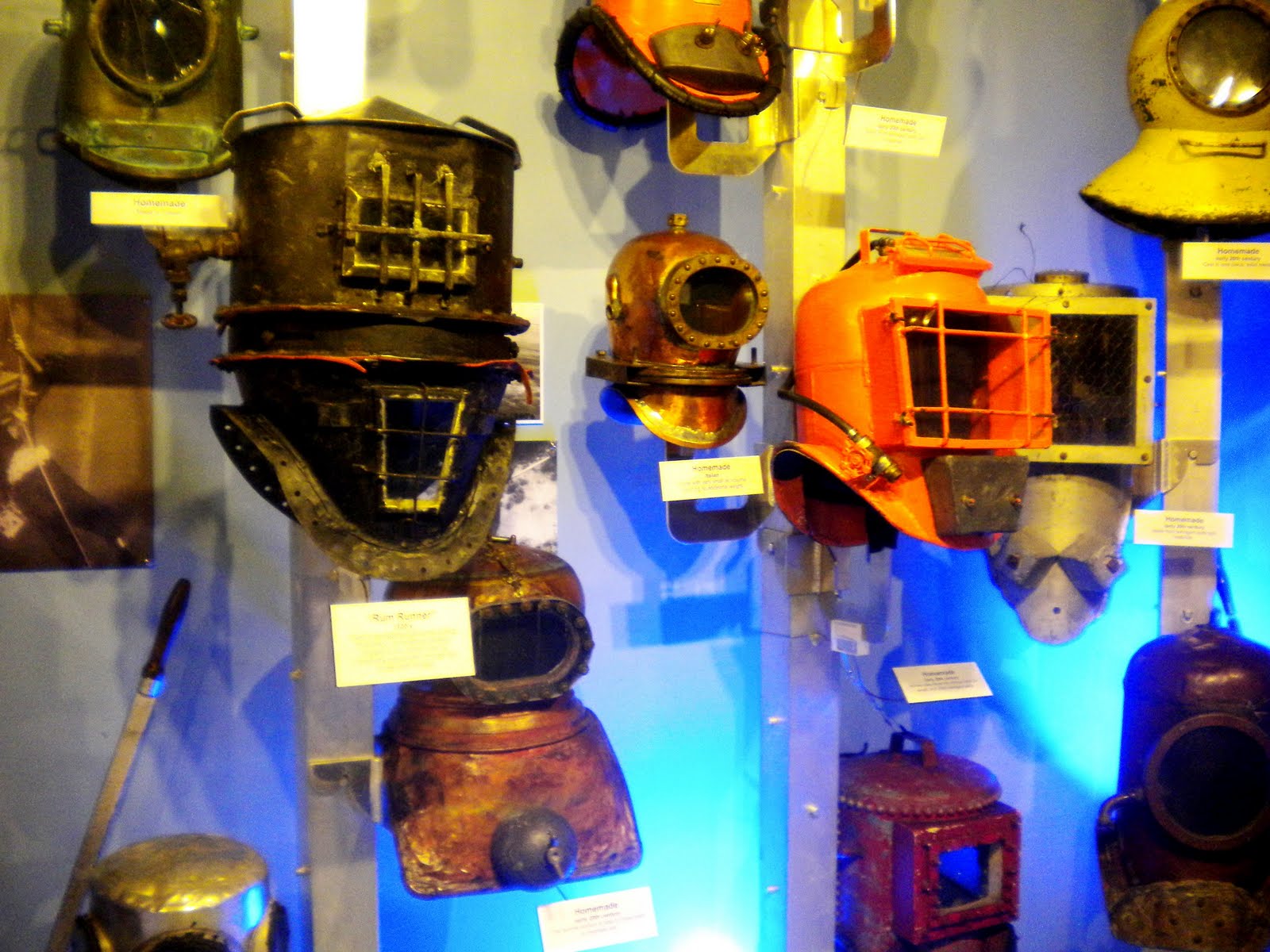
Some of my favorite helmets in our collection can be found in the South Florida Room. The exhibit centers on the Divinhood - the world's first commercially produced open bottom helmet which unquestionably changed diving history. The story of William Miller and William Dunn's Divinhood is a great one - but it is our collection of homemade helmets (inspired by the open bottom concept the Divinhood introduced) that seem to be some of the most popular and memorable artifacts, both for our staff as well as our visitors.


Above is one of our more famous - or infamous - helmets. Dubbed "The Rum Runner," this homemade helmet was used in the 1920's in smuggling operations during Prohibition. Contraband whiskey dropped in the Detroit River by Canadians was spotted through the breastplate window.

The concept of the open bottom helmet was so simple and useful, that craftsmen in garages started using household items to build their own version of the Divinhood. What they produced were many oddly shaped helmets, each truly one-of-a-kind.


Our curator of exhibits, Tim Hemsoth, is finishing this newly constructed wall as I type and it's looking really fabulous. As you can see from the "Before" and "After" photos, Tim has created a "forest" of helmets from floor to ceiling, backlit with a blue spotlight. Enjoy the photos and below and let us know what you think!

Before


After

As a result of redesigning the floor plan in the South Florida Room, we'll also be making some changes to our Underwater Photography exhibit and the Treasure Room in the near future. Below you can see we've taken a wall down to open up the entrance to the Treasure Room and create a better traffic flow.

Hope you've enjoyed seeing all the updates. Stay tuned for more!

-Erin
Manager of Collections and Administration

All photos courtesy of the History of Diving Museum

Friday, November 4, 2011

Henry Fleuss: An Early SCUBA Pioneer

Henry Fleuss (1851-1933) was a diving engineer for Siebe, Gorman & Co. of London. He is widely recognized as a pioneer in the field of diving and some even credit him as the first SCUBA diver. You didn't think it was Jacques Cousteau, did you?


Though he is credited with many other inventions including the Fleuss vacuum pump and a steam car, it is widely accepted that his most important was for the first self-contained breathing apparatus (SCUBA) using pure compressed oxygen. Originally designed in 1876, he was granted a patent for the apparatus in 1878 which freed the diver from having to rely on breathing surface-supplied air.


The apparatus consisted of a rubber mask, a breathing bag, a copper tank to hold the oxygen, and a scrubber. The closed-circuit system was designed to reuse the oxygen by removing the carbon dioxide using a rope yarn soaked in a solution of caustic potash. Originally used to rescue mine workers, Fleuss was lauded for this early SCUBA apparatus.

Its revolutionary and brilliant design became an invaluable piece of equipment for military operations during WWII. The Fleuss rebreather came to be preferred over all other available diving apparatus because it offered the diver total concealment (no air bubbles!).

Although the Fleuss rebreather limited the diver's working depth due to the threat of oxygen toxicity, it was truly revolutionary and is without a doubt a very important part of diving history.

Visit the Museum to learn more about early rebreathers and the evolution of other early SCUBA equipment!

-Erin
Manager of Collections and Administration

Sunday, October 30, 2011

Jake's Journey: Closer to Home


Meet our friend Jake. Some of you may have had the chance to see him on display at First State Bank in Key Largo where he has been on loan for the past two years. Jake has served as an outreach tool for the History of Diving Museum by helping to spread the word about our institution while making many new friends.

After his assignment in Key Largo was up, we were very happy to receive news that Hampton Inn and Suites in Islamorada was interested in 'adopting' Jake to become part of their family. When they assured us that Jake would have plenty of play dates with friends from around the world every day of the week, we knew it was a perfect fit! We are so happy to announce Jake's return to Upper Matecumbe Key. He is now on display just inside the lobby - ready to greet guests and again serve as an ambassador for the Museum.

'Jake', a full-dressed diver on loan from the History of Diving Museum, is now on temporary display at the Hampton Inn and Suites in Islamorada, Florida.

After about a month in his new home, we can report that Jake is very happy and feeling settled. We are so happy to have him closer to home!

The next time you are passing by, visit Jake and make sure he's behaving himself.

-Erin
Manager of Collections and Administration

Friday, October 21, 2011

A Diver and His Helmet: A Happy Reunion

It was a routine business call that brought Jon Hazelbaker to Upstate New York last week, but the series of events that took place were anything but ordinary.

In 1986, commercial diver Jon Hazelbaker was working on a big diving project in Corinth, New York for the International Paper Company. After about three months, the job was almost complete. However, he was called back for a few more days to work on another part of the power plant. After packing up his gear - helmet and everything - Hazelbaker headed back into Albany and checked in to a hotel around 1 o'clock in the morning. The next day started early around 6am. and as he was checking out of the hotel, he discovered that his truck had been broken into. His helmet was gone.

This discovery was completely disheartening, not only because of its obvious monetary value, but because Hazelbaker had accumulated literally thousands of hours working time in it; it was a helmet that he had used and lovingly abused for 16 years.


Devastated, he took out ads in local newspapers and trade magazine with a photo of the helmet (pictured above) and offering a reward for its return. He even sent out letters and photos to local dive shops and other commercial dive firm competitors.

Flash forward 25 years to 2011 when Hazelbaker was assigned by ADCI to perform a safety audit for commercial diving firm Seaway Diving & Salvage - a routine practice in the industry. While scheduling his visit to Waterford, New York, Hazelbaker recited the story of his stolen helmet to the owner of Seaway, Tim Joslyn. After a few minutes, Joslyn said, "I think we have that picture still here." He quickly located the original photo from 1986 in a file and told Hazelbaker that he knew where that helmet was. The previous owner, Kevin Lengyel, had kept the photo around all those years. Overwhelmed with joy, he exclaimed over the phone, "Tim, that is my hat!"

After taking care of business at Seaway, Hazelbaker took Joslyn's advice and soon found himself en route to a dive shop in Clifton Park, New York - ready to get his hat back. Upon arrival, Hazelbaker was asked to identify the helmet in detail, and of course he was able to recall each and every fitting and dent in the helmet, many unique to this particular hat. After a little while, he was finally reunited with his old helmet, almost 25 years to the day when it was stolen.

Commercial diver Jon Hazelbaker reunited with his helmet in Upstate New York.

Hazelbaker gives credit to the owners of Seaway for this happy reunion; to Kevin, who kept the picture around so long, and to Tim who is responsible for putting all the pieces together.

If you have any happy stories like this one, we would love to hear about them!

-Erin
Manager of Collections and Administration

Capt. Jon Hazelbaker is a commercial diving consultant and Board Member at the History of Diving Museum.

Tuesday, October 11, 2011

Remembering an Aquanaut: Dewey D. Smith

As we gear up for our next event, I can't help but to be reminded of a certain helmet in our permanent collection. Next week's program, "Space Exploration and the Aquarius Underwater Habitat" will be presented by a team of Aquanauts and talk about their latest mission with NASA.


NOAA Aquarius Reef Base, colloquially known as Aquarius, is an underwater laboratory located in 63 feet of water approximately 3 1/2 miles offshore of Key Largo in the Florida Keys and is often used by marine biologists studying the reefs. For the past 10 years, NASA has used the underwater habitat for its NEEMO missions to study the effects of extreme environments.

On May 5, 2009, NOAA, Aquarius, and the diving community lost a friend and true hero. Dewey D. Smith was a habitat technician for Aquarius who passed away at the age of 36 as a result of a diving accident. He had worked as a diver with Aquarius for two years and previously served in the US Navy as a Medical Corpsman for five years.

His passing truly left a huge void in the Aquarius family. In honor of Smith's life and legacy, the Aquarius Reef Base donated a Superlite 17 helmet to the Museum. The Superlite 17 is a modern helmet with a fiberglass shell and built-in demand regulator and is the helmet most frequently worn by the Aquanauts. Initially on special display in our Research Library, we are happy to announce that it is now on permanent display in our Commercial Diving exhibit (yellow helmet pictured below).

Every time the Aquanauts come to the Museum for a presentation, you can be sure to find each one paying a visit to the commercial diving exhibit where they remember their friend. We are proud to display this helmet and and honored to present it in memory of Dewey. He will surely be present in all of our thoughts on Wednesday.

-Erin
Manager of Collections and Administration

Wednesday, September 28, 2011

Literacy Month: A New Chapter for HDM

Did you know that September is National Literacy Month? There have been special events happening at libraries, parks, and museums all over the country, and although we haven't had one here just yet (we're planning something special in February!), it has certainly been an exciting month for us at the History of Diving Museum.


We hope that you have already heard about the development of our Research Library, but if not, here's your chance to catch up! Over the past year we have been working on building the Bauer Diving History Research Library, a special collection library and archive to house thousands of books and archival materials related to the history of diving. Funded in part through a grant provided by the Monroe County Tourist Development Council, it is a project that the entire staff has put many hours into and we are excited to see it almost complete. The Bauer Diving History Research Library is named after the museum's founders, Drs. Joe and Sally Bauer.


So what's so exciting about this month??? BOOKS! We have finally begun to fill our bookshelves and let me tell you that after staring at empty bookcases for months and months as we finished construction and technical upgrades (think 70" flat screen TV), it feels so amazing to walk in the space and see the shelves so full and happy. We still have a long way to go as we finish moving books from our Collections Storage into the Library as well as processing the Bauer Collection, but the progress feels great!


The majority of materials come from the Bauer Collection - amassed by Drs. Joe and Sally Bauer over approximately four decades. Their collection contains thousands of rare books as well as photographs, patent drawings, posters, articles, and so much more that will be made available to the public through the very first research library of its kind - dedicated entirely to the history of diving and man's longstanding quest to explore under the sea.

The opening and dedication of the Bauer Library will be held in February and we'll be sure let you know all the details.

Stay tuned to the blog for more!

-Erin, Manager of Collections and Administration

Friday, September 2, 2011

The Divinhood: Practical and Profitable

"A diving apparatus so simple anyone can use it."

That was the slogan for the Miami-based Miller-Dunn Company who designed and produced the Divinhood helmet in the early part of the 20th century. A summary of the significance of this helmet can be found in an earlier blog entry here.

As you may know by now, we love the Divinhood. But before the Style 2 gained fame as the centerpiece for the History of Diving Museum's logo, it was lauded at the time by many for its simplicity, affordability, and practicality. Today I wanted to share with you some contemporaneous quotes from those who used the Divinhood and shared their success stories with Miller and Dunn themselves.

"We want to thank you for building it and congratulate ourselves for buying it."
- W. H. Ebsary, January 12, 1926

"I would not be without it."
- E. F. McDonald, Jr., September 29, 1927

"This is to inform you that since the receipt of the Divinhood we purchased from you two weeks ago, we have recovered over $500.00 worth of merchandise that had gone overboard in Biscayne Bay and could not be found by skin divers. It has already paid for itself."
- John. T. Bennett, July 1st, 1925

"I sat down on a convenient rock, shut my eyes and recited to myself, 'I am not at home, nor near any city or people; I am far out in the Pacific near a desert island, sitting on the bottom of the ocean; I am deep down in the water in a place where no human being has ever been before; it is one of the greatest moments of my whole life; thousands of people would pay large sums, would forego much for five minutes of this!' "
- William Beebe, New York Zoological Society, December 25th, 1925


William Beebe in the Miller-Dunn Style 2 Divinhood

All quotes taken from American Dive Catalog Collection by Ray Mathieson.

-Erin, Manager of Collections and Administration