Wednesday, July 25, 2012

The Writing on the Wall

On February 29, 2012 the ribbon was cut for the Bauer Diving Research Library. The personal collection of Museum founders Drs. Joe and Sally Bauer includes some of the earliest published accounts of the story of undersea exploration and is decorated with unique wall hangings. Visitors to the museum are first shown into our Research Library for a short three minute video about the exhibits. Guests can browse through the room and take a closer look at the shelves and other ephemera items along its walls.  Today we had a pleasant comment from one of our French visitors on the French Banner located near the rare books section. He smiled and said he had never seen a banner like this before and towards the end of the visit exclaimed that not only was he impressed with the collection but also with this particular item. The banner he was referring to was this one:
Banner on display in the Bauer Research Library
Photo from the HDM vault of museum founder, Dr. Sally Bauer holding the banner

The gentleman read the banner and said that he will try to explain in what he called his “broken English” to translate; he mentioned that it was about an association. He paused and started describing with his hands a deep sea diver and said it was in a port near Normandy, the sight of D-Day, North West of Paris. According to an archivist from Le Havre that we have been in contact with, “Union Amicale Des Scaphandriers & Aides Le Havre” translates as “The friendly association of helpers for the divers of the city of Le Havre.”  The banner is believed to be Samite, a luxurious but heavy silk fabric that is often weaved with gold and silver thread. We do believe the thread is real silver and was made before 1910.


It is believed that this society was formed by the families and friends of divers who were killed or injured. The banner was carried in annual procession during holy ceremonies for the Virgin Mary since the original name of the port was The Port of Grace. We are currently trying to find out more details on this particular banner. We will be sure to update you as things develop!
On the opposite wall are some interesting pieces of ephemera items. The main piece that catches visitor’s eyes are the diver cigarette cards.


The cards were used to reinforce and add structural support to the cigarette boxes during the late 19th century. The cigarette boxes during this time were made of paper and easily deteriorated.  At first some cigarette companies used the cards to advertise but later cigarette companies such as Allen and Ginter in the U.S created general interest cards. Since men were the majority of smokers, many popular subjects included famous actresses, cars and sports. In Britain, W.D. & H.O. Wills also began to produce general interest cards in 1895. This is very similar to what later developed as trading cards during the 1930’s. Although they were discontinued after World War II to save paper, one company has started printing them again. The museum managed to acquire the Deep Sea Diver cigarette cards from Victoria Gallery. They were made in 1993 and contain 50 deep sea diver related cards. They are also available for purchase in the museum store. Now you can start collecting too!


More information about each of these cards can be located on this website: http://www.ukdivers.net/history/cigcards.htm
Please feel free to ask about any items in the Library or Museum or if you would like to make a comment about our collection please do so, we would love to read them!


Saturday, June 30, 2012

Pictures from Below: The Development of Underwater Photography

Stephen Frink and I!
Hello there, my name is Denisse and I will be spending most of the summer working in the History of Diving Museum alongside Amber getting first-hand experience in museum operations and non-profit administration. I am very lucky to have joined such a welcoming, fun and knowledgeable staff here at the museum. (Not to exclude a small schnauzer named Simi and local house cat, Mrs.Snickers of course.) The first event in the many to come was the Seminar series that just occurred last Wednesday. It featured Stephen Frink who is a brilliant underwater photographer and got me thinking more about the subject of Underwater Photography. These days underwater cameras have a variety of uses. Underwater cameras can be used for archeological, scientific, building and even artistic purposes. They are also a method of documenting marine life, cave systems, and landscapes.


I decided to take a deeper look into our museum collection and found that it began with William Bauer, a German inventor during the Crimean War in 1865 who was the first to try and capture images underwater by taking photos through the portholes in the submarine. Also in the same year, according to the British Society of Underwater Photographers, the first underwater photograph was taken by William Thompson using a housed plate camera that was lowered to the seabed and operated from a boat. Thompson was inspired by the possibility of using underwater photography to assess the damage done to bridges in times of flood. However it wasn’t until 1893 that the first real underwater photograph was taken by Dr. Louis Boutan. An article by John Humphrey in Science states that Dr.Boutan earned a doctorate in sciences from the University of Paris and had his first diving experience in Banyuls-sur-Mer when they invited him to use the laboratory’s diving suit. He, like many divers, found himself fascinated by the underwater landscape and wanted to capture it. He proceeded to invent a camera that sustained the pressure of the water and had external controls allowing him to operate the camera underwater. Thus the first photos taken underwater emerged after a long 30 minute exposure and up to a depth of 50 meters. Here is a self-portrait of Louis Boutan I managed to dig up from the HDM photo vault, including one of Stephen Frink holding a replica of Boutan's design!

Stephen Frink holding a replica of the camera casing invented by Dr.L Boutan in 1893.
© Stephen Frink/stephenfrinkphoto.com

Now that the impossible had become possible there still remained the problem with lighting and “back-scatter.” Back-scatter refers to the reflection of tiny particles in the water. To diffuse this he invented a magnesium lamp to improve lighting and added a blue filter in front of the lens. And like all devices, underwater cameras have been improved upon and have developed enough to be used to film underwater. The first underwater films occurred in the early 1900’s by Jack Williamson who used a submersible sphere to create a film set underwater.
Submersible sphere by Jack Williamson

This would lead to the making of Jules Verne’s classic, 20,000 Leagues Under the Sea. Other, more compact devices for filming developed in the 1930’s by Yves Le Prieur. Now that underwater housing for camera equipment had developed, it was time to tackle the issue of color. Let it be known that it was here in Florida Keys where the first color photo was taken! Dr. William Longley and National Geographic staff photographer Charles Martin captured a color photo of a hogfish in 1926. The next significant figure is Hans Hass whose special housings and other inventions in the 1940’s led to a higher quality and overall improvement in the field. It was not long before a consumer friendly underwater camera joined the market.
This photo features Hans Hass using one of his cameras.
 Nikon developed the first commercial cameras in 1960’s, the first of which was the Calypso followed by the Nikonos. Although it was discontinued in 2001 the museum has a Nikonos III which is able to take photos up to 50 meters in depth and is all weather proof!

The museum also has some of the camera housings used by Art McKee and a modern underwater camera by Amphibico Inc!
Art McKee's underwater camera housing
 Amphibico Inc

We hope you can join us as all of these can be seen as you tour the South Florida Room here in the museum!

Tuesday, June 26, 2012

Adventures in Greek and Roman Diving


When you walk into the History of Diving Museum, you are met with information and artifacts that have been salvaged from under the sea dating to the Greco-Roman period and even earlier.  You will encounter an intact amphora (a Greek/Roman storage jar) and an amphora fragment that still has some olives in it.  However, these items have been retrieved by modern divers and archaeologists.  What about in ancient Greek and Roman times?  What did they do?  We know from the segment of Aristotle and the image of the wall carving depicting men swimming underwater with air sacs on display in the museum that divers existed 2000+ years ago.  But how did they manage to deal with things like changing water pressure, how far could they dive, and under what circumstances were they diving to begin with?  Most of the sources of information we have that survive today regarding ancient Greek and Roman divers are literary, but this blog will serve to make some sense out of all the information and shed some light on the mysterious world of Greek and Roman diving!


THE INNOVATIVE GREEK AND ROMAN

First, let’s explore how some of the divers prepared themselves for ‘the plunge.’  In the ancient Greek work Problems, which has been attributed to the 4th century BCE Greek philosopher Aristotle (although it is not certain whether he was actually the author of the work), some very fascinating diving techniques of the Greeks are described.  For instance, divers would puncture their eardrums on purpose before they dove so that they wouldn’t have to worry about the changing water pressure the further down they went.  They could just weigh themselves down with a rock and sink to the bottom without wasting time dealing with the pressure on their ears.  Some divers would also shove sponges or even oil in their ears to prevent the water from getting in (32.2-11)

Plutarch (De Primo Frigido, 950B), a Greek-turned-Roman philosopher of the 1st century CE, and Oppian (Halieutica, V.638, 646), a Roman poet of the 2nd century CE, both mention that divers would take a mouthful of oil before each dive.  They claim that when the diver reached the bottom of their dive, they would spit out the oil so that he could see more clearly.  They did not have helmets or protective lenses to aid in their sight in salt water, so they had to improvise.  Some modern scholars, however, such as Dr. Frank J. Frost, have suggested that ancient Greek and Roman divers would take oil in their mouths for an entirely different reason.  They argue that the divers would force the oil up through their eustachian tubes, the tubes that connect the nasopharynx to the middle ear, in order to protect their sensitive ear tissue from exposure to salt water.  There does not seem to be any literary or archaeological evidence to prove this theory.  However, if it does turn out to be true that the ancient Greek and Roman divers used oil this way, it could indicate that they had a more sophisticated understanding of human physiology than what many of the extant literary sources suggest.

Although there do not seem to be too many dangerous predators in the Mediterranean sea today, ancient historians claim that sharks were a definite problem for divers and even discuss ways in which divers tried to keep themselves safe from the carnivorous animal.  For instance, the Roman historian Aelian, writing in the late 2nd/early 3rd century CE, states in his De Natura Animalium (On the Nature of Animals) that divers would blacken their hands and feet in order to try to avoid a loss of a limb from a shark attack (15.11).  What makes this interesting is that to this day it is a widespread belief that sharks are discouraged by dark colors.  Pliny the Elder, a Roman philosopher and author from the 1st century CE, figured out something that modern divers know – that swimming directly at sharks can scare them away (Natural History IX.152-3).


SO, HOW DEEP COULD THEY GO?

Another thing that modern scholars have been fascinated about regarding ancient Greek and Roman diving has been how deep the divers could have gone.  Dives of 90 feet, according to the Rhodian Sea-Law (III.47), were well within ancient Greek and Roman divers’ ranges. Isidore of Charax (Athenaeus 3.93E) mentions pearl divers in the Persian Gulf who descended to 120 feet.  While ancient literary sources must be taken with a grain of salt regarding the accuracy of the information given (ancient historians did like to exaggerate!), compared to modern ‘primitive’ divers, 90 feet for a dive does not seem that unreasonable. 


DIVING AS A BUSINESS

Diving was a way of life for many poor men in Greece and Rome.  The most common form of diving was for sponges, then the murex for ‘purple’ dye, and pearls, among other plants and animals common in the Mediterranean.  According to the Rhodian Sea-Law (III.47-8), divers could keep part of their findings, depending on the depth at which they salvaged the objects.  For instance, if gold, silver, or some other type of material was found at 8 fathoms (48 feet) down, the diver could keep 1/3 of what he found.  If the objects were salvaged from 15 fathoms (90 feet) deep, then the diver could keep half, because of the danger to the diver that deep under water.  However, if items were washed ashore or found 1 cubit (approximately 18 inches) below the surface of the water, then the diver could only keep 1/10 of what was found. 

Diving in antiquity wasn’t just something that poor men did to earn a few drachmas, but was also a business.  There were several corporations that were devoted to fishing and diving and were very competitive, especially in the Roman economy.  Diving was also used for military operations.  For instance, the earliest known documented organized military dive took place during the Peloponnesian War (431-404 BCE).  The 5th century BCE Greek historian Thucydides writes that when the Spartans were being attacked on the island of Sphacteria, divers from the mainland were sent down to bypass the Athenian blockade and bring food and supplies to the besieged Spartan troops (History of the Peloponnesian War IV.26).  Thucydides also describes an instance in which the military of Syracuse drove stakes into the bottom of the harbor around their anchorage to prevent Athenian triremes (a ship with three rows of oars) from getting through.  The Athenians, however, sent divers to go down and cut through the stakes so that their ships could get through (HPW VII.25.6-8).


Sunday, January 22, 2012

One Hundred Years Ago Today...


...Henry Flagler rode a train all the way to Key West. Today we don't think too much of driving over a seemingly endless chain of islands and bridges as we drive from Florida's mainland to Key West (with a stop at the History of Diving Museum on the way, of course). But in 1912, it was a very big deal. Nothing like it had ever been attempted.


The Key West Extension of the Florida Keys Over-Sea Railway was called "Flagler's Folly,"a nod to the fact that many thought it was an impossible feat. But Flagler proved them all wrong on January 22, 1912 when he and wife, Mary Lily, rolled into town on a special Pullman sleeping car. After seven years of setbacks, Flagler's dream had finally come true. For a complete historical timeline of the Florida Keys Over-Sea Railroad, visit this website: http://www.flaglerkeys100.com/fec-railroad-overseas-extension


As this month marks the centennial of this occassion, there has been an upsurge in this (almost) unbelievable story. Several new books have been published, new documentaries produced, and a host of special events held to commemorate this special anniversary.


One thing that hasn't changed much is that we still know very little about the divers who were involved in building the Over-Sea Railroad. There are only two known photographs showing divers from this project. Both are from the collection of the Pigeon Key Foundation.


The Miller-Dunn Divinhood was just coming into popularity at this time, but the divers who worked on Flagler's Railroad wore hard helmets bolted to canvas suits. In other words, they were full-dressed divers. Note the large air pumps in the two photos below. A lot of man power was needed to allow the divers simply to breathe.


We hope you enjoyed these photos. They are staff favorites here at the History of Diving Museum. As always, we're looking for more, so let us know if you know of any other photos of divers from this project or era.


Happy Centennial, Henry!


-Erin
Interim Director/Manager of Collections and Administration

Tuesday, December 20, 2011

Under Pressure: Decompression Chambers

I have to admit, decompression sickness and hyperbaric medicine are two things I know very little about. They are both complex subjects, so I'm very thankful - and grateful - for the doctors who are able to utilize pressurized chambers and oxygen, a gas that we all breathe every single day, to save lives.

Decompression sickness (DCS) is a very serious issue for our sport. Originally coined 'caissons' disease' in the 19th century, it was first discovered in bridge construction workers who experienced joint pain upon returning from working in pressurized enclosures (caissons) at the bottom of rivers and lakes. Today it is commonly referred to as "the bends."

Here at the History of Diving Museum, we have two decompression chambers. The one below is located just outside our building and dates to the 1960's. It features a very simple cylindrical design and two view ports to observe the patient.


It is considered roomy compared to the collapsible chamber located inside our "Abyss" exhibit. This is an extremely rare chamber made by the German company, Drager. Its telescopic quality allows it to fit inside a small box and expand quickly for emergency situations aboard a ship. It also features two view ports for observation.


If you are interested in learning more about how hyperbaric chambers are used to treat the bends and other ailments, join us at the Museum on Wednesday, December 21st at 7pm. Dennis Holstein, Program Director for Hyperbaric Medicine and Would Care Departments at Mariners Hospital, will present a free program, "Hyperbaric Medicine: It's Not Just for Divers."

-Erin
Manager of Collections and Administration
All photos courtesy of the History of Diving Museum

Tuesday, November 22, 2011

Exhibit Talk: Transforming the South Florida Room


Our team has been hard at work on transforming one of our most popular exhibits, The South Florida Room, so I wanted to give an update on the amazing progress that has been made in the past few months.


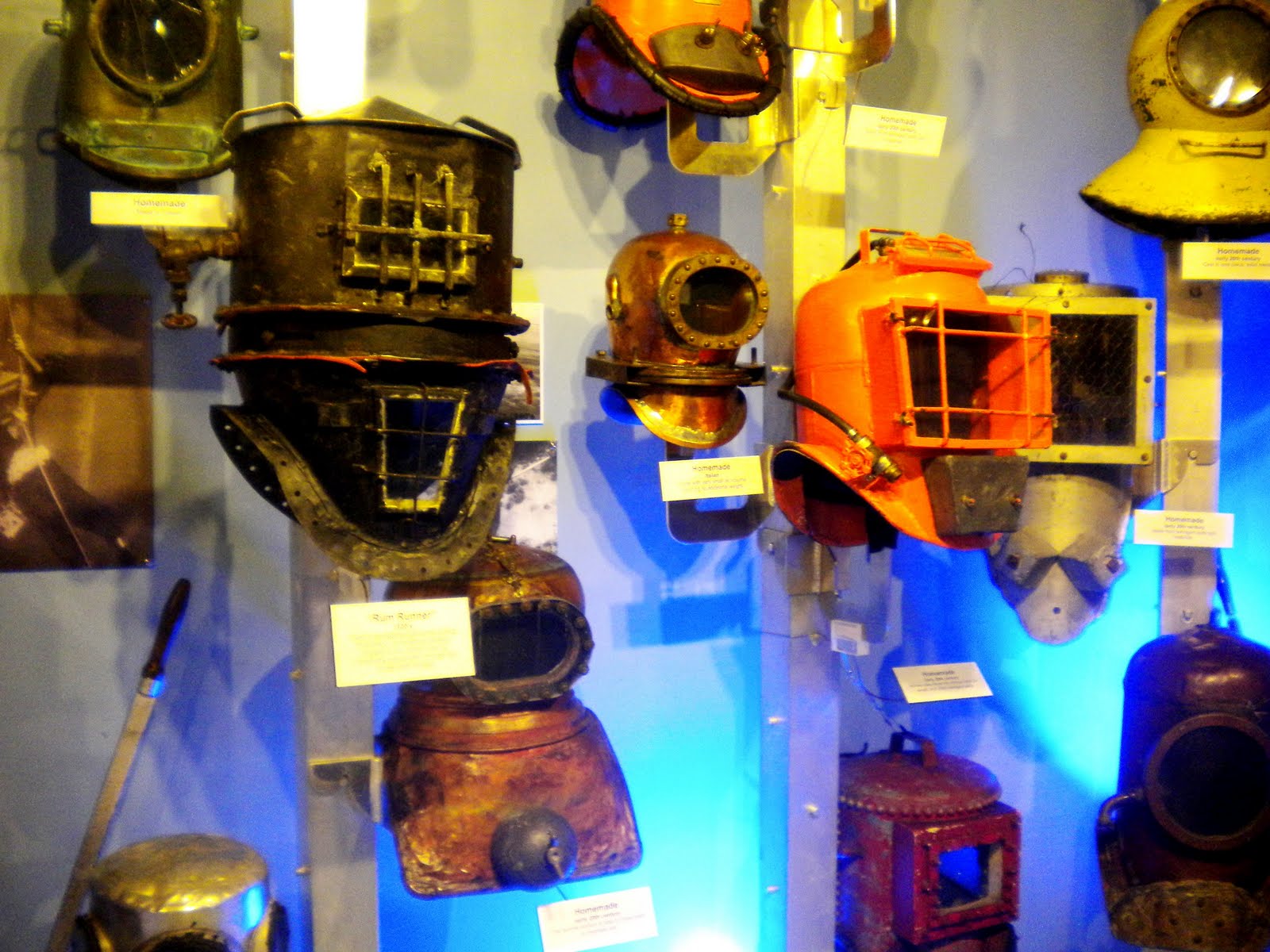
Some of my favorite helmets in our collection can be found in the South Florida Room. The exhibit centers on the Divinhood - the world's first commercially produced open bottom helmet which unquestionably changed diving history. The story of William Miller and William Dunn's Divinhood is a great one - but it is our collection of homemade helmets (inspired by the open bottom concept the Divinhood introduced) that seem to be some of the most popular and memorable artifacts, both for our staff as well as our visitors.


Above is one of our more famous - or infamous - helmets. Dubbed "The Rum Runner," this homemade helmet was used in the 1920's in smuggling operations during Prohibition. Contraband whiskey dropped in the Detroit River by Canadians was spotted through the breastplate window.

The concept of the open bottom helmet was so simple and useful, that craftsmen in garages started using household items to build their own version of the Divinhood. What they produced were many oddly shaped helmets, each truly one-of-a-kind.


Our curator of exhibits, Tim Hemsoth, is finishing this newly constructed wall as I type and it's looking really fabulous. As you can see from the "Before" and "After" photos, Tim has created a "forest" of helmets from floor to ceiling, backlit with a blue spotlight. Enjoy the photos and below and let us know what you think!

Before


After

As a result of redesigning the floor plan in the South Florida Room, we'll also be making some changes to our Underwater Photography exhibit and the Treasure Room in the near future. Below you can see we've taken a wall down to open up the entrance to the Treasure Room and create a better traffic flow.

Hope you've enjoyed seeing all the updates. Stay tuned for more!

-Erin
Manager of Collections and Administration

All photos courtesy of the History of Diving Museum

Friday, November 4, 2011

Henry Fleuss: An Early SCUBA Pioneer

Henry Fleuss (1851-1933) was a diving engineer for Siebe, Gorman & Co. of London. He is widely recognized as a pioneer in the field of diving and some even credit him as the first SCUBA diver. You didn't think it was Jacques Cousteau, did you?


Though he is credited with many other inventions including the Fleuss vacuum pump and a steam car, it is widely accepted that his most important was for the first self-contained breathing apparatus (SCUBA) using pure compressed oxygen. Originally designed in 1876, he was granted a patent for the apparatus in 1878 which freed the diver from having to rely on breathing surface-supplied air.


The apparatus consisted of a rubber mask, a breathing bag, a copper tank to hold the oxygen, and a scrubber. The closed-circuit system was designed to reuse the oxygen by removing the carbon dioxide using a rope yarn soaked in a solution of caustic potash. Originally used to rescue mine workers, Fleuss was lauded for this early SCUBA apparatus.

Its revolutionary and brilliant design became an invaluable piece of equipment for military operations during WWII. The Fleuss rebreather came to be preferred over all other available diving apparatus because it offered the diver total concealment (no air bubbles!).

Although the Fleuss rebreather limited the diver's working depth due to the threat of oxygen toxicity, it was truly revolutionary and is without a doubt a very important part of diving history.

Visit the Museum to learn more about early rebreathers and the evolution of other early SCUBA equipment!

-Erin
Manager of Collections and Administration